Measurement is a core part of practically everything. Whether you’re at home trying to level out your wall hangings, or you’re operating a multi-million-dollar manufacturing facility.
However, it’s not as simple as picking up the appropriate measuring tool and getting to work. Pretty much any measurement tool, if you want spot-on readings, needs to be calibrated before you use it.
So, what is calibration, and why is it so crucial for accurate measurements across nearly all science and technology fields? Let’s take a closer look.
What is Calibration?
Calibration is a fairly simple concept that can be a bit more complex in practice if you don’t have experience with it.
Essentially, you’re using a known standard, usually an already calibrated tool, to check the accuracy of another measurement tool.
For example, let’s say you’re measuring temperature in a fairly precise field. You’d need to test it against something you know is accurate.
An old standard is freeze-temp water to set built-in calibration features, but you could also use a thermometer that you already know is accurate and compare the readings of both.
Then, you would adjust the calibration of the second thermometer to match the one that you know is accurate.
What Types of Measurement Tools are Calibrated?
We used a thermometer as an everyday example. Most people have purchased a new meat thermometer and had to go through a calibration step. However, pretty much every measurement tool needs to be calibrated in some way.
Precise manufacturing equipment, levels, thermometers of various complexities, accelerometers, colorimeters, and more need to be calibrated before they’re used.
Even the lowly right-angle square, one of the simplest measuring tools, needs to be compared to a known right angle to determine its accuracy and usefulness.
Why is Calibration Crucial in Measurement?
So, why exactly is it so important to calibrate your measurement tool? Shouldn’t it be accurate right out of the box?
Well, a manual hand tool, such as a ruler, should be accurate out of the box. Otherwise, you bought something that doesn’t work. You still need to test it, though.
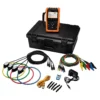
Calibration is typically associated with more complex measurement tools, including electronic devices like electromagnetic field measuring instruments used in specialized industries.
Especially if they’re used in highly precise applications and meant to be adjustable, because they can lose calibration over time and use.
Calibration allows you to dial in the measurement and ensure that every time you use that tool, you measure the piece with 100% precision.
Without calibration, the standards and tolerances achieved in modern applications would be impossible. Even an 8th of an inch’s worth of inaccuracy would render a lot of things useless or completely change the intended results.
Again, with a thermometer, imagine you’re in the culinary field and need to rest a steak exactly to 145 degrees for the perfect presentation. If the thermometer is off, that steak goes from medium rare to medium with just a moment of overcooking.
Similarly, tools like lux meters, which measure light intensity, must be precisely calibrated to ensure correct readings in industries like photography or architecture.
In an application such as medicine manufacturing or architecture, the consequences can be a lot more serious.
Get the Right Measurement Tools and Calibrate with Ease
So, what is calibration exactly, and why does it matter so much in science, engineering, and beyond? Simply put, it’s the process of making sure your measurement tools deliver accurate results.
With our top-of-the-line measurement tools, you can make it easy to get the perfect measurements. Regardless of your industrial space or scientific field, get your measurement tools from AQ Measurement.
Contact us today to find the measurement tools that fit your needs: engineered for easy calibration and reliable accuracy.